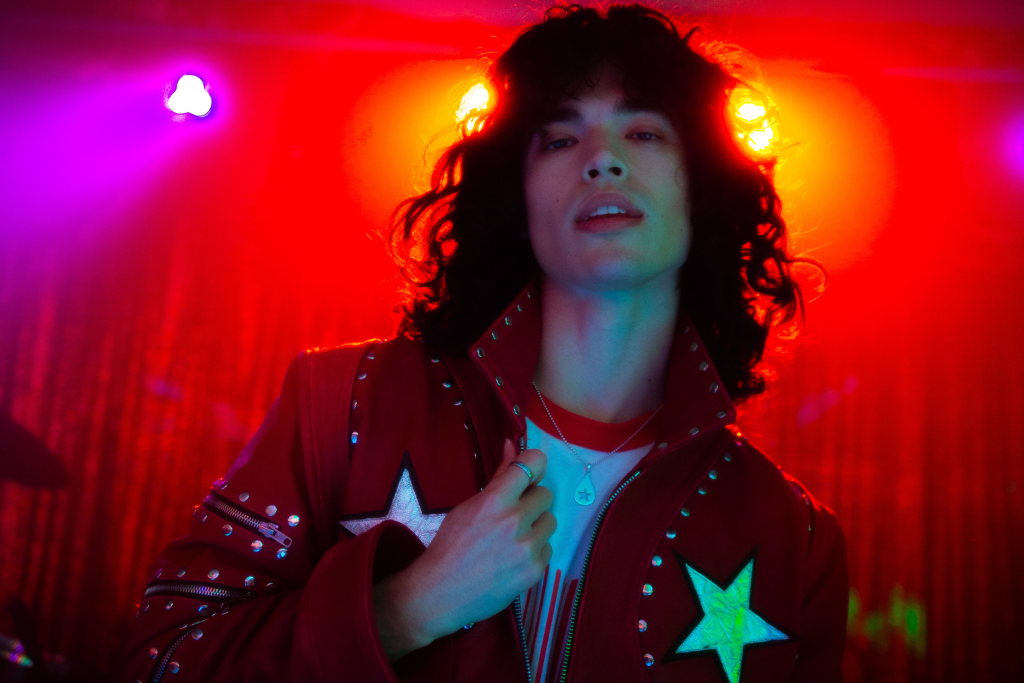
Field of Dreamers: The Crayon Fields let loose
You can tell a good band (or a good person) by the quality of their hare-brained schemes. A person with a worthy hare-brained scheme – a plan imaginative, playful, perhaps a touch romantic – is a person worth knowing. They will take you to interesting places. And a band who, with unabashed enthusiasm, will set down several of their silliest and most spectacular plans for recorded posterity, are a band definitely worth knowing They are going to interesting places. They are a band with A Vision.
The Crayon Fields have A Vision, oh yes, indeed. They have several. So many, in fact, that they might have invented their own parallel universe; a planet where punters draw their own sleeve art, albums are borrowed not bought, and instruments provide renewable energy. In this collectively forged pop utopia, DIY rules supreme, or maybe that should be Supremes. The Crayon Fields, you see, are little people (skinny, fragile-looking, Nice Young Men) refracting their talent through a big telescope. They write warm, shimmering two-minute pop songs that are thrown together with casual, unassuming perfection. Absorbing the glittery best of “pop music from the 60s, 70s and 80s – the Gold 104 playlists of 1991” in their words, The Crayon Fields also have a blurry, bedroom atmosphere, a vari-speed tape-deck wobble. They sound like your younger brother trying to be Stevie Wonder and ending up closer to Stuart Murdoch. There is a hint of Motown, a slight girl-group sparkle, and a gentle psychedelic haze to The Crayon Fields. They are humble and audacious at the same time, attempting to rebuild the best elements of 60s pop on a $60 budget. Take note:
“Geoff was thinking that when we release the album we’re recording at the moment, we could have separate stages [to play on at the launch] – you know, like those 60s filmclips,” explains Neil, The Crayon Fields’ genial and bespectacled drummer.
“Made of table-tennis tables,” nods Geoff, the band’s deadpan, quietly hilarious, and bespectacled singer/guitarist.
“Nah, they’d have to be made of those 80s mini-trampolines,” rebuts Neil. “Little podiums. We could cover them in glittery paper or something.”
And the old-fashioned microphones? “Hanging from the ceiling,” nods Neil. How about an orchestra pit, for added glamour? Neil is still nodding, the rest of the band are murmuring excitably, but Geoff is growing nervous.
“This is going to cost a lot of money,” he says.
Befitting a band whose eccentricity is offset by their natural pop panache – take a listen to their EP The Good Life, on which they sound like Pavement and a doo-wop quartet simultaneously, and marvel at how effortless it sounds – The Crayon Fields have chosen a sprawling Stanley Kubrick exhibition as the setting for today’s interview. Inside the dimly lit museum space, irrefutable icons of popular culture (Jack Nicholson leering out of the darkness, Sue Lyon licking her heart-shaped lollipop) nestle up against the undeniable evidence of Kubrick’s obsessive strangeness. A card-index file detailing the life of Napoleon, anyone?
As we wander about, I’m trying to find an object which sums up The Crayon Fields. After settling on a 7” flexi-single from the Lolita soundtrack – a winning combination of naivety and craft there, I think – it’s time to canvas general band opinion. What Kubrick film best encapsulates The Crayon Fields?
“I think it’s Full Metal Jacket,” declares Geoff, without hesitating.
The original Crayon Fields trio – comprising Geoff, bassist Brett, and drummer Jarrad – formed in 2001 when the members were still at school. Our nascent pop heroes grew up around Melbourne’s northern suburbs, and their first gig, according to Geoff, was “a battle of the bands. I think we came second, and someone told us we were ‘chilled’ and ‘trippy’ while offering us some wet corn chips.”
The Crayon Fields were born out of that decades-old motivator: suburban inertia. “We had little else to do, and we were pasty teens wanting to be looked at under flattering red lights. It was an excuse to buy nice wood-panelled musical instruments, an uncomplicated way to meet interesting people, and an excuse to travel,” Geoff summarises. “It hasn’t changed much.”
Their first EP, The Good Life, was recorded during 2004, capturing their “very three-piecey” sound, as Brett describes it. It opens with the rather incongruous ‘Sweet Little Kids In Your Sad Little Town’ – a song of teenage escape set to jerking guitars and drums, more punk brat than pop tart. But the title track, and in particular, the gorgeous, swooning ‘Lovers In Your Carpets’ – all 57 seconds of it – are a better indication of The Crayon Fields’ approach.
In mid-2005, The Crayon Fields expanded to a four-piece with the arrival of new drummer Neil (Jarrad left to become a tree surgeon), and multi-instrumentalist Chris. There is now, according to Chris (genial, bespectacled, wearer of quality cardigans) “a lot more going on [musically]. I think having a glockenspiel makes a big difference,” he grins, commenting on his main instrument of choice.
So far, it’s all smiles and chimes. So where’s the boot camp then?
“Oh, Geoff’s definitely a drill-sergeant,” laughs Chris.
“Yeah, we do 5am rehearsals,” Geoff shoots back.
A drill-sergeant perhaps not, but there is surely a modicum of self-discipline and tenaciousness operating here. After all, The Crayon Fields have two releases (a 3” CD single was released last year), are currently recording their first album, and have spent the past six months filling some impressively high-profile support slots; Electrelane, Art of Fighting, Kelly Stoltz, The Dirty Three. All this without a manager, or a record label, or any other industry types holding their hands. Surely The Crayon Fields must know what they are doing?
“We’ve been really lucky, people have come to us,” demurs Brett (who, by the way, does not wear spectacles, but is entirely friendly).
Self-deprecating to a fault, the band are as youthfully unimpressed with their recent second-billings – “We seem to do all these adult contemporary supports,” Geoff smiles, “We try applying for the hip supports and they reject us” – as they are with their own attempts at self-management.

“The only things I’ve done [to try and help us] have been completely counter-productive,” argues Geoff. “Except when I put that corrugated cardboard in our 3” single sleeves,” he adds, thinking for a moment.
“That was very nice,” Chris agrees.
“That was a nice touch.”
Currently, The Crayon Fields can be found several days a week ensconced in Geoff’s bedroom, recording an album. The material is a mixture of old and new, with “about a third” of the songs dating back to two years ago.
“When these two joined,” explains Brett, indicating Chris and Neil, “we culled a lot of our old songs and we had to write new stuff. Geoff hates a lot of the old stuff.”
“But we all like it,” adds Neil.
“We’ll have two old songs that we don’t really like,” continues Brett, “but there’ll be tiny pieces that we do like, so we grab those and make them into a new song. That happens quite often. We end up with weird Frankenstein songs,” he laughs.
The Crayon Fields would like to unleash this collection of newly minted monster-mashes upon the public by mid-2006, but as for any labels or release plans, “we have to finish it and see,” says Geoff. “And judging by my work just trying to organise gigs I don’t know how we’d go releasing it ourselves. It could be a disaster. I think our distribution would consist of somebody laying it out in Bourke Street Mall and selling it for stamps.”
It is at this point, discussing the pitfalls of distribution, that The Crayon Fields hit upon a truly Hare-Brained Scheme, one so gloriously odd that you can only hope, one day, it actually happens.
“When people borrow CDs,” muses Geoff, thinking aloud, “they never return them on time. Maybe we could lend the album out and charge huge late fees, and make all our money off of late fees. It’ll be the thing to save the music industry aside from publishing royalties.”
“When we lend out a CD we could take the [borrower’s] name, the date, where it was, and their address,” suggest Neil, warming to the theme. Card-index file, anyone?
Brett senses a minor flaw in the plan. “What if they never return the CD?”
“We send out the debt collectors,” Geoff declares.
Don’t let their diminutive appearance fool you: The Crayon Fields are tough bastards. I know this has to be true because recently I lost their 3” single down the back of my CD player. Have you ever managed to lose a CD while it’s actually inside the player? No? Let me tell you, it takes a special kind of incompetence. It took half an hour to get the bloody thing out again, most of it spent shaking the stereo like a cocktail maker, hearing the CD mischievously rattling around in the works, and swearing rather loudly. Eventually, I took the whole component apart with a screwdriver. The CD was scratched to buggery, and I guess I’d voided the stereo warranty. But you know what? It turned out they were both fine.
I was mighty glad too, because that little disc contains what is currently my favourite two minutes and fourteen seconds of pop music; a song called ‘Helicopters’. The first time I saw The Crayon Fields live, they played this song, and by half way through I was a fully paid-up band Fan, waiting on my membership card and 1” button badge. If there were no other reasons to love them, I would love them for this song. It is as great as Belle & Sebastian’s ‘The Boy With the Arab Strap’, or The Jam’s ‘A Town Called Malice.’ And that is truly, genuinely great, and a lower-case throwaway pop great too, not a capital letters musical statement rock GREAT, which of course makes it greater still.
How does anyone manage to write a tune so deliriously catchy? How is it that every element – the shkkha-shkkha tambourine, the organ shimmy, the boyish vocal about spinning in circles – is so perfectly calibrated? Recorded, it’s the kind of obscure gem that you’d put on a mix tape and send across the world, just to spread the joyous news. Live, it has a lovely, bottom-heavy tilt guaranteed to get your feet moving. So how’d they do it? Surely you need a lab to come up with this sort of thing: mathematical charts, market surveys, computer software expressly designed to deliver you A Hit. Surely you can’t just sit down in your bedroom one day and write it. But apparently you can.
Brett says that ‘Helicopters’ is “the oldest song to have survived” through to their current set list. “Geoff wrote it before the first EP,” he says, and it “is now played twice as fast.” It was originally known as the ‘Three-Quarter Song’, because, as Geoff reasonably explains, it was only ever “three quarters of a song”.
“It’s funny,” ponders Neil, “the songs are short, but in the old days the names used to be really long.”
“That was just Geoff being an idiot,” Brett counters. “We had five different names for each song.”
“The longest was ‘I Woke Up In A Disco Casino and the Soap Looked Like Food’,” proffers Geoff.
“But that wasn’t really what it was called,” Brett adds, rather confusingly.
This writer’s theory (not a very original one, to be sure) is that it is far more difficult to write a transcendently good pop song that it is to come up with a ten-minute improvisational collage. Anyone can hide their disdain for craft (or rather, their lack of talent) behind off-key mumblings and laptop noise. But not everybody can write a cracker tune. The Crayon Fields, ever humble, beg to differ.
“Ah no, it’s pretty simple,” declares Chris.
“It’s actually a bit dumb, sometimes,” says Brett.
“Though if you’re like me, writing simple things can be a difficult task,” Geoff adds quietly, in a way confirming my theory, although I think he means it differently.
Well, what about writing happy music then? Surely it is an exceptionally difficult task to write music that makes a listener genuinely happy, without coming across as teeth-grindingly twee?
“I don’t think we set out to make happy music,” argues Brett.
“I think it’s got something to do with the glockenspiel, it makes everything into Tinkerbell,” Chris says, although his grin betrays the fact that he is not too displeased with this idea. So if a glockenspiel sprinkles musical fairy-dust on everything, what would it take to add instant, street-cred level angst?
“Well, I think we’d have to get the 12-string guitar in,” says Geoff.
“I think we need a harpsichord, to balance it out,” suggests Chris.
“Substance abuse,” Brett nods.
“I think that [what we do] is an expression of frustration at not being able to make sad music, because we’re so limited by our abilities,” Geoff says, adding an air of psychoanalysis to proceedings. “We want some accordion on the album, and I think that’s going to be a real challenge.”
“I always thought that with the energy of an accordion you could power a factory,” he continues, unblinkingly. “And you’d always hear this distant sound of accordion. Wind energy. We could go to CERES [community garden in Melbourne’s East Brunswick] and make a proposition.”
Startling images of giant accordions, connected to a factory by a tangle of oversized pipes, being squeezed by teams of hamsters, or perhaps Oompa Loompas, come to mind. It would be like Fritz Lang’s Metropolis, only with a soundtrack of constant wheezing. Surely it would drive every worker without a 50-kilometre radius stark raving bonkers?
“But it could make people happy, it’s quite upbeat,” argues Neil. “Kind of like cotton-picking songs.”
The Crayon Fields then, reviving the grand tradition of the working song?
“Well that is essentially what we’re about,” grins Neil. “Actually, there is a song we just recorded that I listened back to yesterday, and it made me smile,” he says, suddenly regaining the thread of the conversation. “It was very happy.”
“Didn’t you say that it was like Strictly Ballroom?’ asks Geoff sceptically.
“No!” defends Neil. He pauses, thinking. “I mean, yeah, elements of that. The Loveboat theme, it’s got a bit of that in it. But it’s good. I think.”
+
Their first EP was Worms, not The good life.
I absolutely cannot be fucked searching for correct threads any more. I am listening to The Field's new album. It's good. 'Leave it' is a stellar track. I also adore Geoff O'Connor.
'Yesterday and today' is also good if you can ignore the weird slap bass angle. Guh.
I can't be stuffed reading the article.
But The Crayon Fields are a great band who deserve everything they get, and more.
They should go overseas and get some Pitchfork attention.
Unfortunately they seem to manage doing one without the deserved other.
Emmy Hennings made me want to write for Mess+Noise.
hey timewaster, crayon fields have been written up on pitchfork a bunch of times (Animal Bells got a 7.8 review!), and they are currently on tour in Europe!
Me too, AH. Me too. The AOF article she wrote destroyed me.
New video at:
Youtube:
Vimeo:
hmmmmm..
http://www.youtube.com/watch?v=QeR87HqOUqM
http://www.vimeo.com/4026020