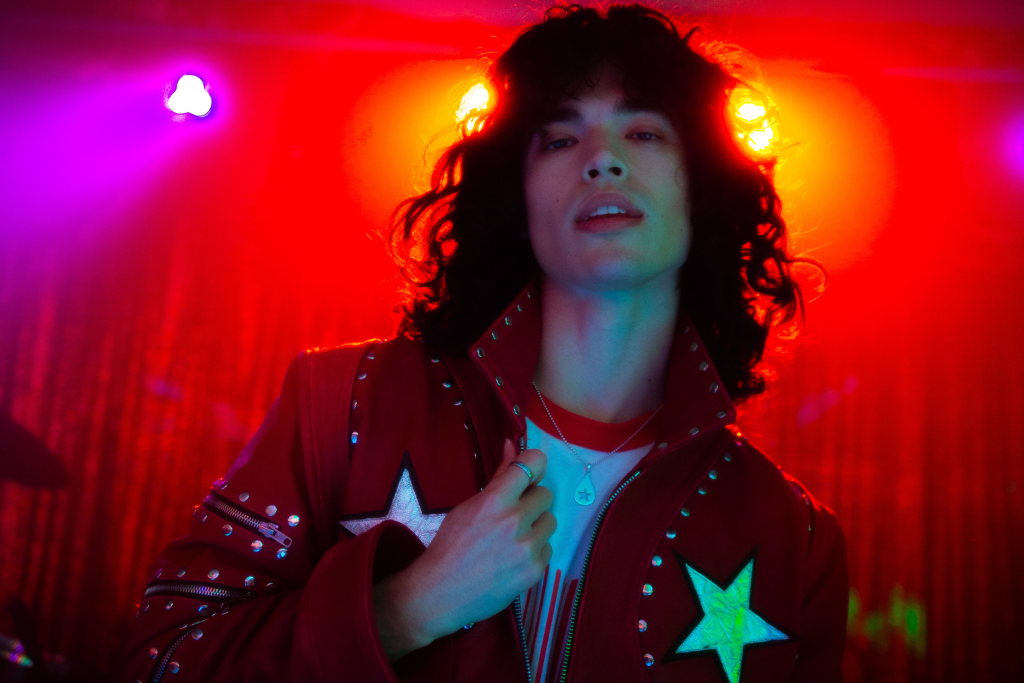
Guns Are For Kids Break It Down
Sydney’s Guns Are For Kids are taking rock & roll to pieces and starting again from scratch.
I. McBranding
In a revealing study published earlier this year in Archives of Pediatrics and Adolescent Medicine, researchers in California quizzed 63 preschoolers on what tastes better: french fries in plain packaging, or the same fries in a McDonald’s wrapper. 77 percent of those kids claimed that the McDonald’s chips tasted better. The researchers then repeated the experiment with chicken nuggets, with 59 percent of the young ’uns giving the McDonald’s-branded variety the thumbs up.
These results aren’t entirely surprising – we were all kids once, and the blinding allure of the golden arches can be hard to resist when you’re four-years-old and don’t know the meaning of the word cholesterol. What’s really disturbing is that 54.1 percent of these same kids chose baby carrots in Maccas packaging over the non-branded variety. Baby carrots? They’re not even on the McDonald’s menu.
“That’s the kind of thing that fires us up,” says Audrey L. Carpetbag, axe-slinger for Sydney quartet Guns Are For Kids.
“We’re just trying to hold the mirror up a lot of the time to the frustration we feel and hoping that it resonates with people,” says Oswald Mainstream, the band’s vocalist and sometimes bass player. “We don’t write depressing music, we don’t think, but it challenges people and is uncomfortable. We feel uncomfortable with a lot of things in this world. We don’t want to be preaching about it, but if people can’t recognise that, they’re not going to get our band. We’re all about change, in the world and in our own minds, and our music represents that. This is our way of expressing our discontent, showing how confusing it is and trying to find a voice.”
II. No! You’re Playing It All Right!
Guns Are For Kids have been a band now for almost two years. It’s been a steep learning curve for them, with Mainstream coming to the band with no prior experience as a bass player, and drummer Reverend Helix Also lacking much background behind the kit. In this way, the group has essentially had to start from scratch – hence the rough-cut nature of their debut EP, Too Much Red Not Enough Red.
“The band was developing through that EP,” explains Mainstream. “That’s part of the beauty of it, that it does chart a course. The first and last tracks, they’re really the last section of what we were writing, and what we were most happy with. Most bands are like that. Your newer stuff’s always your favourite. It just feels like it’s much more accomplished and much more focused. It gets to the point quicker. We just cut off all the fat and moved further away from our influences.”
Since the band’s inception, songwriting has proven itself to be a trial-and-error process more than anything. And oftentimes it’s the accidents – the mistakes, the bung notes, the non-musical surprises – that make the cut. “It’s almost like we want to unlearn things to come at this from a really bizarre angle,” says Mainstream. “Having something played perfectly… don’t get us wrong, we don’t want to play everything wrong just for the sake of it. But we’ve realised that that chaos delivers something interesting and intrinsic to our music. Now we’re trying to get the most out of that.”
III. Fenced In
Everything about Guns Are For Kids seems jagged, broken somehow. Too Much Red Not Enough Red sounds, maybe, like they took six rock songs – the kind with chords and choruses and such things – and threw them against a brick wall, then tried gluing the remaining fragments back together. Blindfolded.
“Our whole manifesto for the band is just dismantling the idea of what music is,” says Mainstream. “We don’t write chord progressions. We have hooks, but they’re more rhythmic.
“Music’s not a thing to be painting yourself into a corner with,” he continues. “It’s a wide expanse. How do jazz musicians write, how do classical musicians write, how do folk musicians write? Looking at those differences and then looking at what we are and how we play our instruments, that’s really where we’re at. ‘Hear that groove? Let’s try something like that.’ Then we’ll change two things and add something else. That’s how you write a song. For us, anyway. It’s an experiment and a learning curve. An education in music. It’s not just, ‘hear three bands that you love, copy and repeat.’ We’re not into that. We’re into exploring sounds and learning about music our own way.”
“I’ve always thought of it as a massive field with these fences around it,” adds Carpetbag. “As long as you stay in that field somewhere, and everyone knows where the change is or roughly knows that something is about to come up, you’ve got so much room to move. Me personally on the guitar, almost every song is played differently every night.”
IV. Id & Ego
On Too Much Red Not Enough Red, melody takes a back seat to the band’s careening rhythm section, shards of guitar flashing in and out of focus as the songs, seemingly of their own volition, lunge forward. Lyrics are fractured, almost Burroughs-esque phrases that (for the most part) scorn traditional patterns of repetition and meter. There are aspects of these songs that echo No Wave groups like James Chance and the Contortions and Mars, and you could, were you so inclined, draw a direct line from the raw violence of the EP’s title track or ‘Exactly Different’ to that of The Birthday Party or Suicide.
“I guess you always have the obvious inspirations,” nods Carpetbag. “A particular tone might be reminiscent of a Birthday Party album or Pere Ubu or something like that. But whatever. Those guys sounded just like The Pop Group, you know what I’m saying? Where does it end?”
Guns Are For Kids don’t exist in a vacuum. No artist does. Knowing that, and knowing that there are explicit similarities between their approach and those of other bands, the band find themselves constantly assessing, reassessing and challenging their own identity.
“Where is the self in all this?” asks Mainstream. “Where is the personality of who we are? We can have the same ideas as other people have, but they’re not us and we’re not them. That’s the difference. That’s our strength. No-one will ever be able to copy that or change what that is.”
V. Bought & Sold
There’s a primitivism at work in Guns Are For Kids, a throwback of sorts to a time when music had more of a sacred, almost ritual role in society. A time before it became, as Carpetbag puts it, “just a one and a zero that you whack in your iPod”. Since Thomas Alva Edison invented the phonograph back in 1877, the way humans interact with music has changed drastically. As soon as music became something tangible – something to have and to hold, and more importantly to own – it became commodified. There’s no logic in arguing against this advancement; who would dare suggest that music would be better if there was no such thing as an album? But it is something to be aware – perhaps even wary – of.
“I remember reading this book by Herbert Marcuse called One-Dimensional Man,” says Carpetbag. “It was written in the ’60s, and is an attack on society and consumerism. He basically said that very thing. The theatre was where you’d go, back in the day, to see a musical piece, and it was the highlight of your year. Those people up there performing were gods. And then it got trimmed down and down and down.”
“It’s an art form,” adds Mainstream. “It’s not just rock & roll. A lot of people go, ‘Ugh, here we go, talking about music as an artform.’ But really, it is. Every culture in the history of civilisation has had music. I’m not saying that we’re linked to that in our music particularly, but music itself is.”
VI. Push Th’ Little Boundaries
Apparently, Brian Eno once said that only a thousand people bought The Velvet Underground and Nico, but everyone who did when on to form a band of their own. Like that god-awful dancing about architecture quip, the origins of the quote are shrouded in mystery. Nonetheless, the sentiment stands. Some bands’ success can be measured in record sales, but there’s a whole raft of hidden others who dwell just beyond the radar’s reach, and whose legacy is about more than how many t-shirt designs they’ve got lined up on the merch table.
“Look at The Birthday Party,” Mainstream says. “They get kicked out of Australia for being too weird, go to England, then 20 years later Nick Cave comes back to the adoration of everyone. Plays the Sydney Festival, does his own piano tour… I mean, it’s madness. It’s just a matter of sticking to your guns. If you hang in there long enough, people stop saying you’re insane and start saying you’re amazing.”
“Suicide have probably sold more albums these days than they ever did while they were together,” adds Carpetbag, incredulous. “That in itself is mind-boggling.”
“Really, for us it’s just about liking what we’re doing at that moment,” Mainstream says. “Pushing ourselves and challenging ourselves. In the context of the record industry or whatever, people make decisions not so much related to their music but to the industry, what people will think about it and how many units they’ll sell. We’re not interested in that. We just want to make the music we like. We’re thinking about whether people will like it as we perform it, but that’s just a secondary thing. I mean, we don’t write songs like Coldplay or anything. We write deconstructed music. That for us is a good thing because it the parameters up much wider, people won’t expect a certain thing from us. It’s exciting. It’s exciting for us, and hopefully it gets across to other people and is exciting for them.”
+
What happened to these guys?
The broke it down.
Oh. That's a shame.
I actualy don't know.
Sorry.....