View the Mobile Version of M+N

Featured Articles

The Cops: Counting The Beat

The Cops may divide audiences, but with their new album they again prove that they know what they want.

Simon Carter should feel confident and relaxed. His band’s latest single was voted into January’s Triple J Hottest 100 and preparations for their second album have just been wrapped-up. But he doesn’t. Especially not when he and Beck Darwon, the other driving force behind The Cops, aren’t asked any of the questions they prepared for.

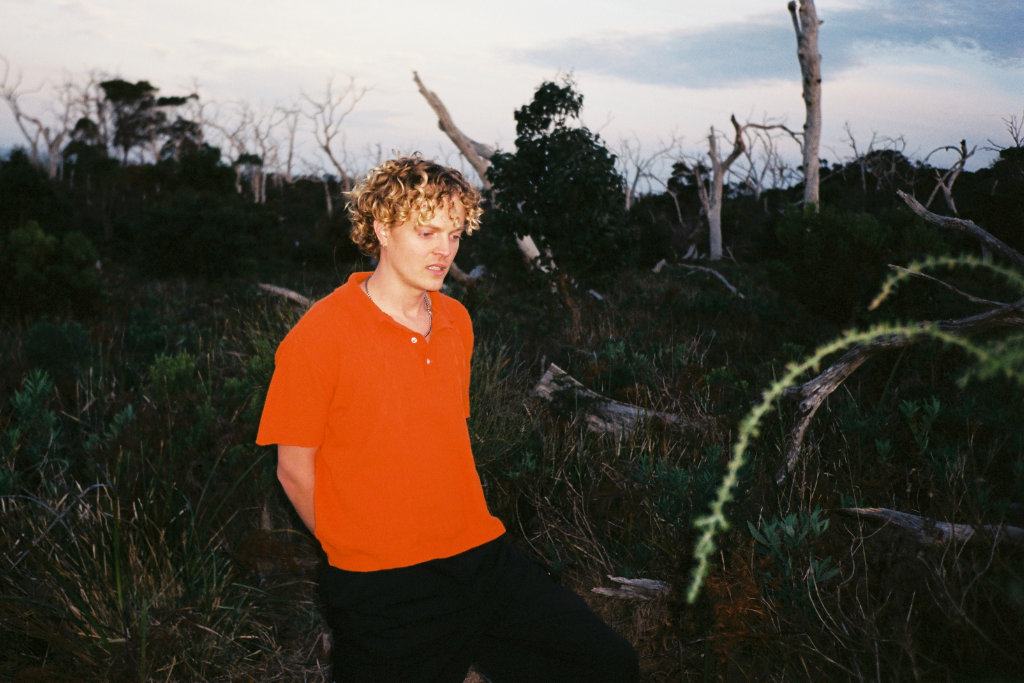
Tall, very white and very thin, Simon is sitting at a table in a redeveloped hotel in Sydney’s residential inner-west, wearing frameless glasses and a loose polo shirt that is unbuttoned more than it needs to be, revealing a thin necklace and a relatively hairless chest. He looks half-way between a Miami Vice extra and a computer geek.

To his left is Beck, slightly tomboyish and medium-height, with long, straight brown hair and more energy than anyone else in the room. Facing him is a sweaty, unfit journalist who drinks pints of cheap beer and caught in the table’s outer orbit is a young record label publicist who glances half-heartedly over figure sheets while eavesdropping on the conversation and providing the occasional laugh-track. When the musicians are asked about their favourite video games, Simon looks ahead quizzically for a moment before smiling a little, and the publicist frets that this is going to take longer than scheduled.

Beck grew up with Prince Of Persia, and Simon with the real-time strategy Dune II.

Drop It In Their Laps, The Cops’ second album, sounds very little like their first, Stomp On Tripwires. It has a sprawling, shameless ’80s pop aesthetic, with enough talent to pull it off. The melodies are sugary and supplemented with strings, handclaps, keyboards and vocal harmonies. In terms of reinvention – and almost in grandeur – it is comparable to The Sleepy Jackson’s Personality… And almost every track on the album is accompanied, as is so important in the band’s hometown at the moment, with a beat people can dance to.

When the popularity of dance music exploded in the late ’90s, Sydney had more clubs, doofs and come-down parties than Melbourne does scarves. With a few exceptions – the city’s two pub rock institutions, The Hopetoun in Surry Hills and The Annandale on busy Parramatta Road, and a new experimental underground in Marrickville to the west – the city still bears the marks, physically as much as psychologically, of club culture. Bands play parties as often as gigs, and the DJs are still often the main attraction.

Six or seven years ago, the epicentre of mainstream dance music in Sydney was Home, an enormous, UV-lit club wedged between three manufactured tourist precincts on the bottom end of Cockle Bay Wharf in Darling Harbour, which saw more glo-sticks than any other building in the country. This month, it was the venue for the announcement of the second annual, rock-heavy Australian Music Prize, where bands such as Augie March, Sarah Blasko and The Drones were in competition for a $25,000 prize; far less than would have changed hands in the club on an average weekend night during its peak.

The AMP’s announcement at Home is a sign of this decade’s shifting tastes. Rock bands have started to come back into the CBD, but change has been through metamorphosis rather than revolution. Thus the integration of dance and rock sections in Sydney streetpress and the current crop of bands underpinned by a dance beat, who choose a keyboard or synthesiser over another guitar, who reference 80s pop and dance on stage. The Presets, teenagersintokyo and Riot In Belgium have all found praise in this context, as well as like-minded Melbourne acts such as Midnight Juggernauts and Muscles, who could sell twice the tickets on Oxford Street as they could in their hometown.

The Cops aren’t an electro-pop band, but it’s hard to imagine Drop It In Their Laps coming from anywhere else in Australia at the moment. It sounds like the Sydney summer fed through a synthesiser, in parts superficial, unapologetic and even arrogant, in others relaxed and upbeat. The album is designed for just two things: a dance floor or an afternoon spent wrapped in headphones, in a bean bag with a smile. It’s pure pop.

Drop It is a step above The Cops’ first album. Released in 2004, Stomp On Tripwires was a mix of fast, lo-fi rock & roll and pop tunes which earned the band equal measures of applause and contempt. “Best thing I’ve heard in years,” read one comment posted on Triple J’s audience reviews page, followed by another describing the band as “fashion wankers riding the new rock wave”. It was fun but patchy, and the band seemed to have anticipated its reaction. “If you think my songs are shallow,” Simon sang on ‘Cop CITY Music’, “Well, hey now, now, you can stick it up the arse of my cowbell, honey.” Not surprisingly, such quips didn’t go down too well with detractors.

“We’ve got our own hate club and all that kind of stuff,” laughs Simon. “It’s bizarre, but I guess that’s what happens when you’re in a band and you’re in the public eye and your music is out there. There are a lot of people who like it and a lot of people who dislike it. Sometimes [the attacks] get quite personal, but it seems to come from people who don’t actually know us. Somebody said I had false teeth! I was like, ‘What do you say to that?’”

“We’ve got our own hate club and all that kind of stuff,” laughs Simon. “Somebody said I had false teeth! I was like, ‘What do you say to that?’”

Simon and Beck aren’t exactly rock stars. At the Summer Hill Hotel on a hot afternoon, they describe their idea of a party: sitting in a lounge room on a weekend night working their way through their manager’s vast record collection with a bottle of wine or two. Simon is a shy, asthmatic smoker, who later pauses during a phone interview to drag on his inhaler, and Beck is his chattier, more confident counterpart. They are the heartbeat of The Cops. Simon writes the songs, and Beck lets him know which ones are shit.

Simon: “Beck is the other integral part of The Cops. I wasn’t actually going to form a band. I had all these songs but I was kind of doing it for myself. I wasn’t confident enough to go out and search for musicians, especially knowing how hard it is to find good ones. It was through Beck… you know, she gave me the confidence to start a band and she’s such a fantastic PR woman. She put it out there. She knows so many people in the scene that it was easy for her to get it all together and to get members of the band, to get the demo out there, to talk to people and get people excited. It’s not The Cops without her. Whenever I write a song, I take it to her and ask what she thinks. I really respect her opinion, because I know that we have exactly the same music taste.”

Beck: “In some ways it’s great that I’ve got The Cops, because it feeds my addiction to MySpace. I love it. The fans are so nice. They’re just so sweet. If you comment them, they get so excited about it. They’re like, ‘Oh my god!’, and I’m like, ‘Do you think that I’m sitting here in my chateau in the south of France or something?’ If they try to take that over from me, they’re going to have to find me something else to do. It takes an hour out of my day. I get home from work, I get a glass of wine and I sit down there and that’s my job for the day. We all have little jobs to do and that’s my job, and I love it.”

The pair met through a friend, who Simon was dating at the time, and bonded over a shared history as musical outcasts. While other teenagers were nodding along half-heartedly to Pearl Jam and Soundgarden records in the schoolyard, Simon and Beck were wiggling to Britpop bands with short hair and in-turned toes (perhaps explaining why ‘Respectagon’, from the new album, sounds like a Pulp track). They went on to play in a string of bands before starting The Cops ¬– Beck in The Dilemmas and more prominently Fyreflyes and Simon in Women Of Troy, Hush Honey and Bulletproof. After moving cities and schools as a child while tagging along after his father’s work, Simon settled in Summer Hill just over a decade ago. Beck has been around longer, having grown up in neighbouring Croydon Park, 15 blocks or so to the west.

On a map, Sydney Harbour looks like a huge spike jammed horizontally into the coast, about half the length of the greater city. Sydney’s wealth is spread from east to west, concentrated where the water flows in – Vaucluse, Mosman and Double Bay – and trickling about 40- or 50-kilometres inland to Penrith. From the CBD, which peaks at the southern end of the vertically-running Harbour Bridge, the inner suburbs spread out like an upside-down umbrella. Paddington, Woollahra and Bondi lie to the east and to the west are Newtown, Leichhardt and Marrickville. To generalise, people with money and designer dresses live in the east, students, artists and journalists in the west (with Surry Hills stuck in the middle, directly under the CBD). Both sides have the same gorgeous brick terraces and cottages, but while the east is cool and shady, with the water breeze and leaf-canopied streets, the inner-west feels hot and sun-blasted in comparison.

Summer Hill is one or two suburbs west past Leichhardt, along the monstrous Parramatta Road, which runs all the way from Central Station to Liverpool, then turns south to Goulburn and onwards. It’s a tiny suburb with a small but busy train station and a few tidy shops. Simon works a few blocks from the Summer Hill Hotel on Smith Street at a cafe his parents bought a few years ago, where school teachers come to mark exam papers and ask good-naturedly about The Cops. Beck works at a medical clinic that allows her flexible hours to travel and rehearse. She recently gave up her second job as a piano teacher to focus on the band. This would have been her 12th year teaching. Both are smitten with the suburb, despite, as Beck notes, its lack of a decent seafood shop.

Beck: “My boyfriend was a real Surry Hills boy. When we decided to move in together, I thought it was going to be a very difficult transition for him. But he’s actually taken to it really well. A lot of people think it’s really far out, but it’s not. I think it’s great. There’s so much going on. Between here, Marrickville, Leichhardt and Five Dock, you’ve got Greek and Vietnamese on one side and Italian on the other. The food that is going on!”

Simon: “Newtown’s quite expensive now. [People] are steadily moving out because of the rent.”

Beck: “All the yuppies moved in there. All of the university students who used to live in Newtown have had to move out further – to Petersham, Marrickville and Stanmore. Jarrod [Murphy], our guitarist, lives right up the top of Marrickville. The suburb goes up to this point, where you can look out and see all over Sydney. It’s one of the highest points in the inner-west. He lives on the top floor and you can see everything around.”

The sounds on Drop It were forged in suburban lounge rooms as much as by the city outside. Simon explains the shift in style between the first and second albums purely in terms of the albums he was listening to at the time. The bulk of Tripwires was recorded three years before it came out, when Simon was spinning The Strokes and The B-52s, and the rest – including the most popular tracks ‘Cop CITY Music’ and ‘Wallet/Puffer/Smokes/Keys’ – was written just before its release, after he had discovered funk.

It’s no surprise that the new album was the product of a musical diet heavy in disco, funk, soul and R&B. Simon and Beck perk up when discussing their favourite albums, as if the thrill of record shopping had never worn off. Their favourites of late fall into a jumble of unconnected genres from home and abroad, including Dappled Cities Fly, Justin Timberlake, Sarah Blasko and Muse. They may be record geeks, but not snobs.

Simon: “We don’t really go out that much anymore, because it’s too expensive and there’s nowhere interesting to go. We’d rather spend the money to buy booze we can take back and listen to music on people’s stereos, than spending like $150 a night, and not getting to listen to the music you want to listen to and getting sweaty and shouting.”

Beck: “We do listen to a lot of music. I think the best way for us to do that is be at home. Honestly, it’s once a week if not twice a week that Simon and I are just sitting down, listening to music and having a couple of drinks. We’re always discovering new stuff and it’s hard to do that if you go out a lot. Our manager, Michael Stranges, is an absolute boffin. We’re talking one complete wall and a half of CDs and vinyl. It’s basically, ‘What do I want to listen to? What should I know about?’ and he’ll just find you stuff. He’s great at making mix CDs for you and stuff. [Pauses] I can’t believe I’m saying mix CDs.”

Simon: “[Last time] we had pizza and we listened to music and we drank. That’s pretty much it, really.”

Beck: “Simon will listen to a lot stuff I haven’t heard and he’ll go, ‘You have to listen to this’. That’s what our Friday and Saturday nights are like. The other thing is that we get, from various places and people that we know, a lot of promo copies of people’s albums and stuff. We always listen to them.”

Staying on top of what other bands are doing makes Simon feel connected to the music scene, even if he’s given up on going out too often. It also makes him grateful for the position The Cops have found themselves in. For their new album, the band have signed with Inertia, making them the first direct signing to the distribution company’s roster. Unlike some musicians, Simon’s not sceptical of record labels. He doesn’t seem the suspicious type. He’s just happy to have somebody else backing his band as much as they do. And to make sure he doesn’t say “stupid stuff”, which, rather disappointingly, he doesn’t.

Simon: “I have played so many gigs around this city for absolutely no money, not even a free drink, over 10 years. All of us have. It’s like a level thing. You work really hard and then you move up a tiny level where you get gigs at a better venue. And then you move up another little level, when you get some interest from managers and somebody wants to look after you. And then the next little level up is securing a record deal. We feel that the next little level up for us is having a promotions department, which is so new to us. We’ve done so many years of trying to promote ourselves and we know how fucking difficult it is. We used to scrounge around for change to get fifty stickers made up. Now we have a promotions department. We always have to sit back and think, ‘This is wild.’”

+

  -   Published on Sunday, April 15 2007 by Andrew Ramadge.
Related Artists


Your Comments

You need to be logged into Mess+Noise to contribute to the Articles.
Go on and Log In or if you you're not a member, feel free to Sign Up.

Today On Mess+Noise
Playlist
Selected tracks from the Australian contingent on next year's Laneway circuit.

Related M+N Content